400G wavelength division technology is a bearer technology for the next decade. The total bandwidth of the 80*400G system reaches 32T. Considering the current traffic growth, network construction cost, and technology evolution, priority is given to the construction of 400GE port supporting networks in the backbone 163 hotspot areas and some metropolitan IP services, as well as the large bandwidth bearer scenarios for government and enterprise customers of East Data West Computing, multi-AZ connections between clouds, and intelligent computing:
Backbone communication network: From the current analysis of the growth of backbone 163 traffic and flow direction, the traffic between the major economic circles of Beijing-Tianjin-Hebei, Yangtze River Delta, Guangdong, Hong Kong and Macao, and Chengdu-Chongqing is relatively large, and the long-distance 400G QPSK technology can meet the construction of regional ROADM networks. Other areas of the backbone network can continue to use the original 100G ROADM network for traffic carrying. For some provincial trunks, PCS-16QAM technology can be considered, with a capacity of up to 48T and a lower cost than QPSK long-distance technology.
Metro communication network: Around the East Data West Computing hub node, the bandwidth growth in the provincial trunk and metropolitan area is expected. According to the expected traffic growth, 400G networks can be built in some provincial trunk hub nodes, East Data West Computing nodes, and metropolitan core nodes to meet the demand for bandwidth growth.
Cloud-to-cloud large bandwidth network: For highly reliable multi-AZ cloud-to-cloud and cloud-to-intelligence interconnection scenarios, the current 100G network has a total bandwidth of 8T, which cannot meet its business needs. Considering the occupied computer room, power consumption, operation and maintenance, and single bit cost, it is better to introduce 400G or higher speed to solve the requirements of large-scale data processing and storage for high-speed interconnection.
Four future development trends
The popularity of ChatGPT has promoted the construction of domestic intelligent computing centers. With the implementation of intelligent computing centers, intelligent computing applications will be launched quickly, and AI-generated videos will become easier and easier, further generating new traffic and promoting network connections. With the expansion of the application scale of 400G, the maturity of the industrial chain will further promote technological innovation and reduce manufacturing costs. In addition, with the development of silicon photonics technology, the future 400G wavelength division system will be more efficient, energy-saving, and less expensive.
If you want to build 400G dwdm transmission network, welcome to contact Ivy from HTF. ivy@htfuture.com
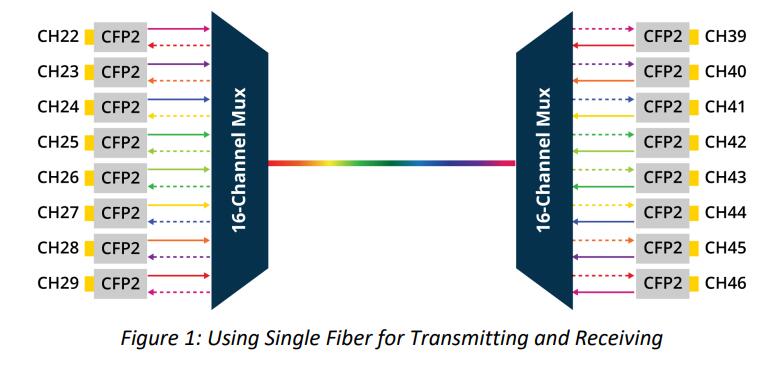
Fiber optic networking used to require two fibers, one for transmitting and one forreceiving signals simultaneously. Single fiber solutions emerged as a way to reduce costs ofdark fiber solutions and optimize fiber. Rather than using two dedicated strands, a single fiber strand that carries a bi-directional signal is used.
For enterprises leasing dark fiber from providers, the operational savings are significant. The challenge is to maximize revenues while reducing their largest expenditure - monthly cost of the fiber link. Using single fiber reduces operational costs by 50%, making dark fiber an affordable solution.
In DWDM, active and passive solutions for single fiber transmission range from 4 up to 8 400G wavelengths, with optional optical amplifiers. The single fiber solution seamlessly
integrates with any standards-based 10/25/100Gb Ethernet, 16/32G Fibre Channel, and OTU2/2e/4 client interfaces, and supports any mix of up to 400G services.
Single fiber solutions are recommended for the following applications:
• Point-to-point, ring or linear add and drop topologies, where installing new fiber is difficult or expensive
• Enables splitting enterprise traffic over two different fibers as opposed to using the same fiber for the entire traffic
• Increase reliability to an existing dual fiber solution by using one fiber for transmitting and receiving, and one for protecting.
The single fiber solution is more efficient and economical for many applications and needs, and provides the same performance and throughput as the traditional dual fiber solution. It enables customers to utilize single fiber for both transmitting and receiving, significantly maximizing their investment and reducing costs such as monthly leasing, taxes, or laying additional fibers.
The solution is transparent to the client optical interface and suits 400G, 100G, 10G, and sub-10G with any client interface mix. It incorporates a single mux with 8 or 16 channels. Half of the mux is used for transmitting and half for receiving.
If you need single fiber soluiton, welcome to contact HTF team, HTF will help you design the suitable DWDM solution. Support single fiber or dual fiber.
DWDM is often used by telecommunications, cable and data centers as part of their optical transport network.
Carrier Transport Network
The carrier transport network is made up of several layers of aggregation called the access network, metro aggregation network, edge network and the core backbone network. DWDM is most often used in the metro aggregation network and the core backbone network.
DWDM in the metro aggregation network is used to combine data from several cities. As service providers bring more computing capabilities closer to their customers, DWDM is also flexible enough to meet their needs for higher bandwidth aggregation as they begin to converge more data into a single node to compute. The core backbone often deals with the high-speed switching of large amounts of data between their major central offices, which can span across several regions, states or even countries, which is also ideal for using DWDM.
If need more information, welcome to contact HTF. www.htfuture.com
Erbium doped fiber amplifiers (EDFA) are now the most preferred and widely used optical amplifier for long-haul fiber-optic communications.
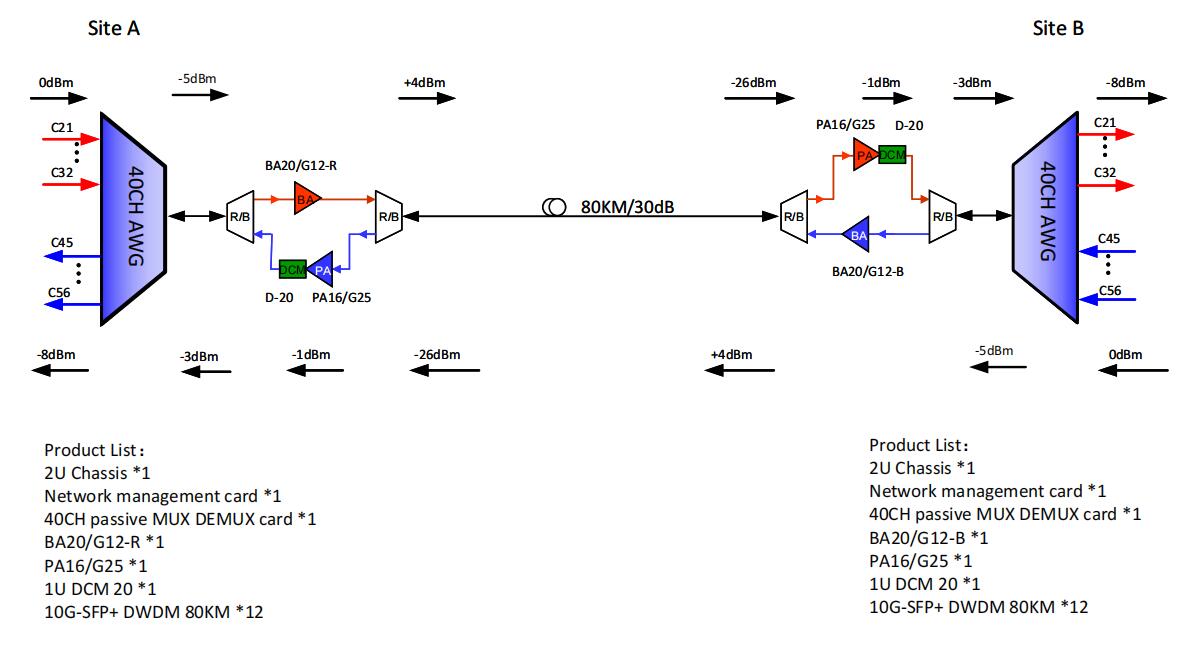
Booster amplifier (BA), in-line amplifier (LA), and pre-amplifier (PA) are the three types of EDFAs used in DWDM optical transmissions. They are typically deployed in combinations and placed at different locations along the transmission line to ensure that the signal is transmitted to the receiver.
The booster amplifier works at the transmission side of the link, which is used to amplify the optical signal before it launches into the fiber link. It is characterized by high input power, high output power and medium optical gain.
The in-line amplifier operates in the middle of the optical link, which is designed for optical amplification between two network nodes. It features low to medium input power, high output power, high optical gain, and low noise figure.
The pre-amplifier is placed at the receiving end of the optical link and is used to compensate for the losses of the demultiplexer near the optical receiver. It is characterized by medium to low input power, medium output power, and medium Gain.
#OLP#DWDM#Datacenter#Protection#HTF For example, you want to transmission 100G from Site A to site B. There are 2 routings, you only choose routing 1, If the optical cable is broken, the transmission is interrupted.
You choose 2 routings, add OLP, Routing 1 is primary link , and routing 2 is secondary link, If the optical cable is broken, the transmission will automatically jump from the primary link to the secondary link. Ensure uninterrupted business
Add OLP, need double routing. If you don't have redundent routing, suggestion not add OLP.