Driven by the rapid development of mobile communication industry, 5G network has boomed. However, 5G also faces some challenges such as the higher transmission bandwidth requirement. How to solve these problems? The WDM-PON network may be a better solution. This post will explain the advantages of WDM-PON technology and how it helps the 5G deployment.
Overview of WDM-PON Network & 5G
As it’s known to all, WDM-PON (Wavelength Division Multiplexing-Passive Optical Network) combines WDM technology with PON topology structure that allows operators to deliver high bandwidth to multiple endpoints over long distances. It includes some technologies, including colorless ONU technology, Auxiliary Management and Control Channel (AMCC), optical modules, OAM, and protection switching. With these key technologies, WDM-PON is regarded as an ideal solution which can meet the 5G requirements and has attracted great attention nowadays.
5G stands for the fifth generation of the wireless mobile network. It will be built on the foundation created by 4G LTE to allow people to send texts, make calls, and browse the web, etc. These upgraded 5G performance targets contain higher data rate, energy saving, higher-quality and massive device connectivity.
5G network

Why Choose WDM-PON for 5G Deployment?
As mentioned above, WDM-PON owns some useful technologies, which have unique advantages in 5G applications, including high bandwidth, low latency, low costs, fiber savings, easy maintenance, etc. The following will focus on introducing some of its merits.
High Bandwidth
The WDM-PON technology allows for traffic separation within the same physical fiber by different wavelengths. This results in a network that provides logical point-to-point connections over physical point-to-multipoint network topology. Moreover, AMCC signal modulation helps stack a management channel onto each wavelength. Therefore, the solution for carrying 5G front-haul over WDM-PON can offer a dedicated wavelength and extensive bandwidth resources to each user, saves time and increases transmission efficiency.
Low Latency
Having AMCC technology to deploy 5G, there is no need to use frame processing or dynamic bandwidth allocation (DBA) scheduling. This architecture provides low latency, low-frequency jitter, and flexible configuration of different front-haul interfaces.
Low Costs
With PON topology, it reduces the number of fiber needed by 5G front-haul networks with high site densities. The existing fiber infrastructure and equipment room are utilized, which saves the deployment and maintenance costs. What’s more, WDM-PON carries out an integrated front-haul/middle-haul (XHaul) transport network with the OLT. This OLT platform and the DU pool can be deployed in the same equipment room, which reduces the equipment construction costs. In addition, using the colorless technology of ONU in WDM-PON system results in low costs.
WDM-PON Network for 5G Deployment
Unlike the 4G which has the BBU and RRU two-level architectures, the 5G is constructed as three entities: CU (Centralized Unit), DU (Distribute Unit) and AAU (Active Antenna Unit). And 5G has three application scenario, including front-haul, middle-haul, and back-haul transmission. In the 5G Front-haul network, WDM-PON can be an efficient solution.
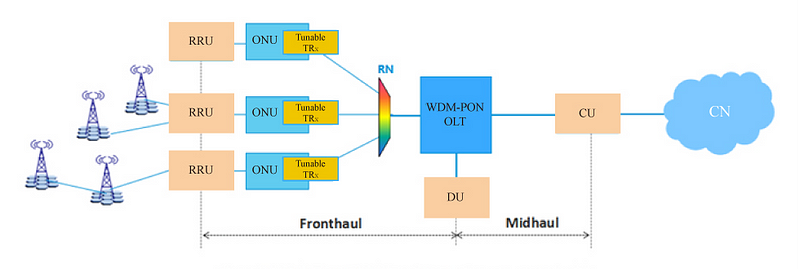
The following figure 1 shows the architecture of WDM-PON 5G front-haul network. Several RRUs and a DU are connected through a WDM-PON point-to-multipoint topology. The WDM-PON OLT is connected to the DU, CU, and ONU. ONU is also connected to RRUs. This OLT platform carries the front-haul traffic between the DU and RRUs as well as the middle-haul traffic between the DU and CU. In terms of the front-haul transmission or the connection between RRUs and DU, WDM-PON transmission interfaces play a significant role that enables the transparent user data transmission between them. In addition, the solution of applying WDM-PON to carry 5G is especially suitable for those operators who have to provide both wireless and wireline services in a greenfield scenario.
WDM-PON network
Summary
As boasting these advantages such as high capacity, low latency, cost-saving, etc., WDM-PON network is considered as an important solution for 5G. And the use of WDM-PON technology would become very common. To pave the way for the upcoming 5G network, HTFuture is striving to be the innovator in 5G communication. In fact, HTFuture has developed optical transceiver modules for WDM-PON network such as DWDM SFP+. If you have any needs, welcome to visit www.htfuture.com
HTFuture aim to be your Reliable Partner for different kinds of Compatible transceiver (QSFP28, QSFP+, SFP, XFP, SFP+, PON, Tunable, Copper, BIDI etc) | OTN optical transmission system|DWDM Mux Demux|OADM | OTU | EDFA | NMS | DCM | OLP | OBP etc| More information, welcome to contact Ivy, contact Ivy. Email: sales6@htfuture.com Skype: live:sales6_1683
HTFuture team are ready and happy to assist you.