显示标签为“OTN SYSTEM”的博文。显示所有博文

2023年7月9日星期日

Things You Should Be Aware of Before Deploying an OTN Network

 If you are about to deploy an OTN network by yourself or get a customized OTN solution from solution suppliers, there are some details and requirements that you should know in advance.

How many spans do you have, and how far between each of the spans?
The specific distance your network transports will determine the fundamental equipment needed in the OTN system. Specifically, the transmission distance between each span will indicate whether the Dispersion Compensation Module (DCM) would be needed to compensate in the fiber optical link.

What’s your fiber type and the link loss (typical 0.25dB/KM)?
OTN solutions offered by solution suppliers can be tailored to both dual and single fiber types. And link loss is necessary for collocating the most appropriate optical transceivers and some active components such as EDFA amplifiers.

What’s the data rate between each span? And how many businesses do you plan to transmit?
To make clear the data rate and capacity for each span in your network are conducive to choosing the most practical types of MUX or OADM for your current OTN infrastructure. And a good acquisition of the number of businesses you are to deploy can pave the way for future network expansion.

Optical Transport Network Solutions

 Optical Transport Network Solutions

WDM MUX/DEMUX, Optical Add/Drop multiplexer (OADM), EDFA, WDM transponder/muxponder, optical line protection (OLP) card, variable optical attenuator (VOA), etc. are the products used in OTN networks. For different network requirements of every individual network task, the equipment deployed in an OTN network can be various. Following list of some common OTN-based products as well as their functions.

The following Item and Function:
WDM MUX/DEMUX Provide high-performance signal division and multiplex

OADM Add/drop the selected wavelengths in one or multiple channels
EDFA Extend the power budget over long distances
WDM Transponder/Muxponder Provide functions such as electrical and optical signals conversions and wavelength conversion/additional functionality of multiplexing

OLP Optical line protection for optical power monitoring and automatic switching
VOA Variable optical attenuator for optical power management

Five Key Benefits of OTN Network

 OTN network combines the advantages of optical transmission and electrical processing to provide end-to-end, transparent pipe connections, increased spectral efficiency, and large-capacity transmission capabilities for long-haul transmissions. The primary benefits of the OTN network are presented as follows.

Standard Hierarchy — OTN standards include a standard multiplexing hierarchy, defining exactly how the lower-rate signals ascend into the higher-rate payloads. This allows the WDM platform to shift lower-rate services within 10Gbps, 40Gbps, or 100Gbps wavelengths, without the need for external wavelength demultiplexing and manual interconnects.

Transport Capacity Expansion — OTN networks provide the underlying high-capacity infrastructure for core interoffice, metropolitan interoffice, and broadband business-access networks. Carriers deploy OTN to support the greatest number of services on the least amount of infrastructure.

Reduced Cost — With multiple clients transported on a single wavelength and their specific requirements preserved, the OTN network reduces the overall cost of transport and ensures efficient bandwidth utilization.

Transport Flexibility — Network operators can employ the technologies needed to support current transport demands, while also enabling future adoption of new technologies as business needs dictate. It can easily scale to ring networks, end-to-end networks, and mesh networks.

Timing Transparency — Timing transparency is important for offering wholesale services to third-party providers. The transparency of OTN enables the networks to carry any service, including Ethernet, storage, and digital video, as well as SONET/SDH without interfering with the client timing.

What Is OTN Network — Optical Transport Network?

 With the explosion of digital traffic and the ever-growing array of bandwidth-hungry applications, Optical Transport Network (OTN) evolves from point-to-point DWDM remedies to scalable and robust optical networking applications that cater to a wide variety of client signals with equally-varied service requirements. Carriers are also placing a particular emphasis on OTN in the Metro area, where it is shifted rapidly from SONET/SDH to wavelength-division multiplexing (WDM). With the goal of boosting bandwidth and increasing network functionality, OTN provides a way to support different traffic types in a more cost-effective manner than by using SONET/SDH networks.

What Is OTN Network?
Defined by the ITU Telecommunication Standardization Sector (ITU-T), OTN is a digital wrapper technology that provides an efficient and globally accepted way to multiplex different services onto optical light paths. The OTN technology or digital wrapper technology provides a network-wide framework that adds SONET/SDH-like features to WDM equipment. It creates a transparent, hierarchical network designed for use on both WDM and TDM devices. (More information about WDM and TDM systems is available in Optical Wavelength Bands Evolution.)

OTN integrates functions of transporting, multiplexing, routing, management, and supervision, and builds OTN client (e.g. SONET/SDH, IP, ATM) connections in the Metro and Core networks. Nowadays, it is widely deployed in the metro, regional, and long-haul DWDM packet-optical transport networks.

If need more information, welcome to contact HTF team, HTF team is ready and happy to assist you. ivy@htfuture.com +8618123672396

2019年7月29日星期一

Differences Between Pre-Amplifier, Booster Amplifier and In-line Amplifier

Transmission distance has always been a key factor during deployment of fiber optic network. DWDM technologies, which are considered as the most cost-effective ways to increase the network capacity over long transmission distance, have been widely applied in our telecommunication network. To further extend transmission distance of optical signals transmission from the DWDM fiber optic transceivers, optical amplifiers are usually used in the DWDM network. Different types of optical amplifiers have been invented to meet the signal amplifying requirements at different situations. This post will introduce the differences between the three most commonly used optical amplifier: pre-amplifier, booster amplifier and in-line amplifier.

Basics of Optical Amplifier

In the past, if you want to extend the transmission distance of DWDM network, optical regenerator station is required to be installed in the fiber link every 80km to 100km. The regenerator station will electronically regenerate the optical signals to overcome the power loss and ensure that the optical signal can be detected at the receiver end. However, this requires a lot of money and is not easy to upgrade the whole network.

With optical amplifier, things become much easier. The optical amplifier can enlarge the optical signals without the regeneration. In addition, the network upgrading is more cost-effective with optical amplifier. Each optical amplifier has an important factor which is operation gain measured in dB. The operation gain of the optical amplifier should be carefully calculated to ensure the network performance. Pre-amplifier, booster amplifier and in-line amplifier are used in different places in the fiber optic network. And they support different operation gain according to the whole network requirement.

Pre-Amplifier, Booster Amplifier and In-line Amplifier

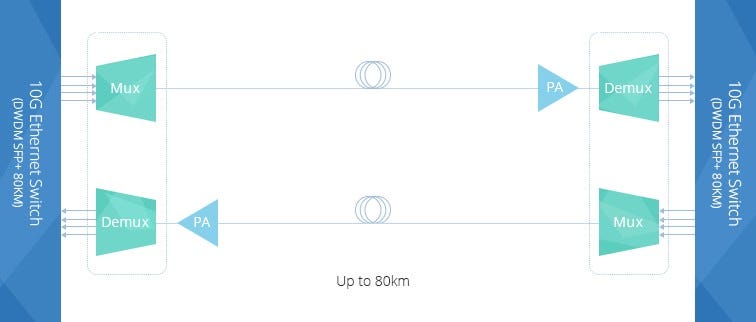
Pre-Amplifier is usually installed at the receiver end of the DWDM network to amplify the optical signal to the required level to ensure that it can be detected by the receiver. The following picture shows a typical diagram for a duplex 10G DWDM network which can support 80km. A pre-amplifier is installed at each receiving end of this network. There will be great power loss after the optical signal goes through the 80km optical fiber. Then, pre-amplifier installed at the receiver end is necessary. Generally, a pre-amplifier should offer high gain to ensure that the optical signal is detectable.

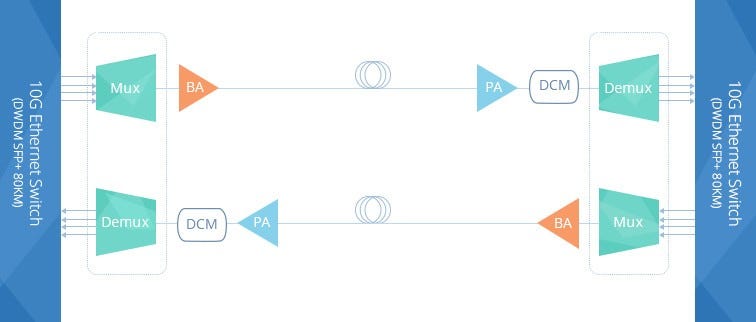
Booster Amplifier is installed in the transmitting end of the fiber optic network, which can amplifier the amplify the optical signal launched into the fiber link. It is usually used in DWDM network where the multiplexer attenuates the signal channels. The following picture shows a 10G DWDM network using booster amplifier (BA) at the transmitting end and pre-amplifier (PA) at receiving end. Thus, this 10G DWDM network can support a transmission distance much longer than the above mentioned one. Please note, a DCM (Dispersion Compensation Module) is added in this network to further ensure the transmission quality. A booster amplifier usually provides low gain and high output power.
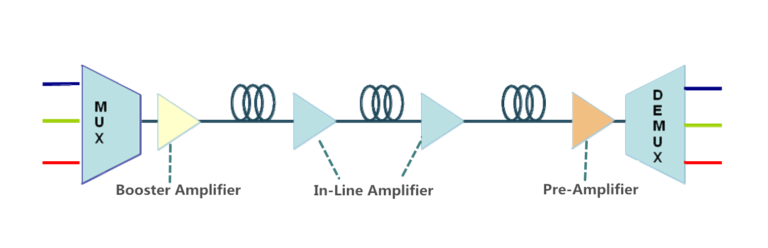
In-line Amplifier is easy to understand. The gain provided by the pre-amplifier and booster amplifier might not be enough due to the optical loss caused by long haul transmission. In-line amplifier is installed in the fiber optic link every 80–100km as shown in the following picture. It has moderate gain and has similar output power to those of booster amplifier.
Conclusion

Optical amplifier can help to amplifier the optical power during long haul transmission to ensure that the receiver can detect the optical signal without error. Three amplifiers are commonly used in DWDM network. Booster amplifier is used to amplifier optical power at the transmitting end and pre-amplifier is placed at the receiver end. If the transmission distance is longer than 150km or have great power loss during transmission, in-line amplifier is suggested to be installed every 80km to 100k in the fiber optic link. The gain of these amplifiers should be carefully calculated during practical use. Kindly visit DWDM EDFA Amplifier page for more details.

HTFuture aim to be your Reliable Partner for different kinds of Compatible transceiver (QSFP28, QSFP+, SFP, XFP, SFP+ etc) | OTN optical transmission system|DWDM Mux Demux|OADM | OTU | EDFA | NMS | DCM | OLP | OBP etc| More information, welcome to contact Ivy, contact Ivy. Email: sales6@htfuture.com Skype: live:sales6_1683
HTFuture team are ready and happy to assist you.

Which thing need consider when deploy 400G between data center distance in 120KM?

  In an era characterized by explosive data growth and the relentless expansion of cloud computing services, the demand for high - speed and...